 Image 1 of 1
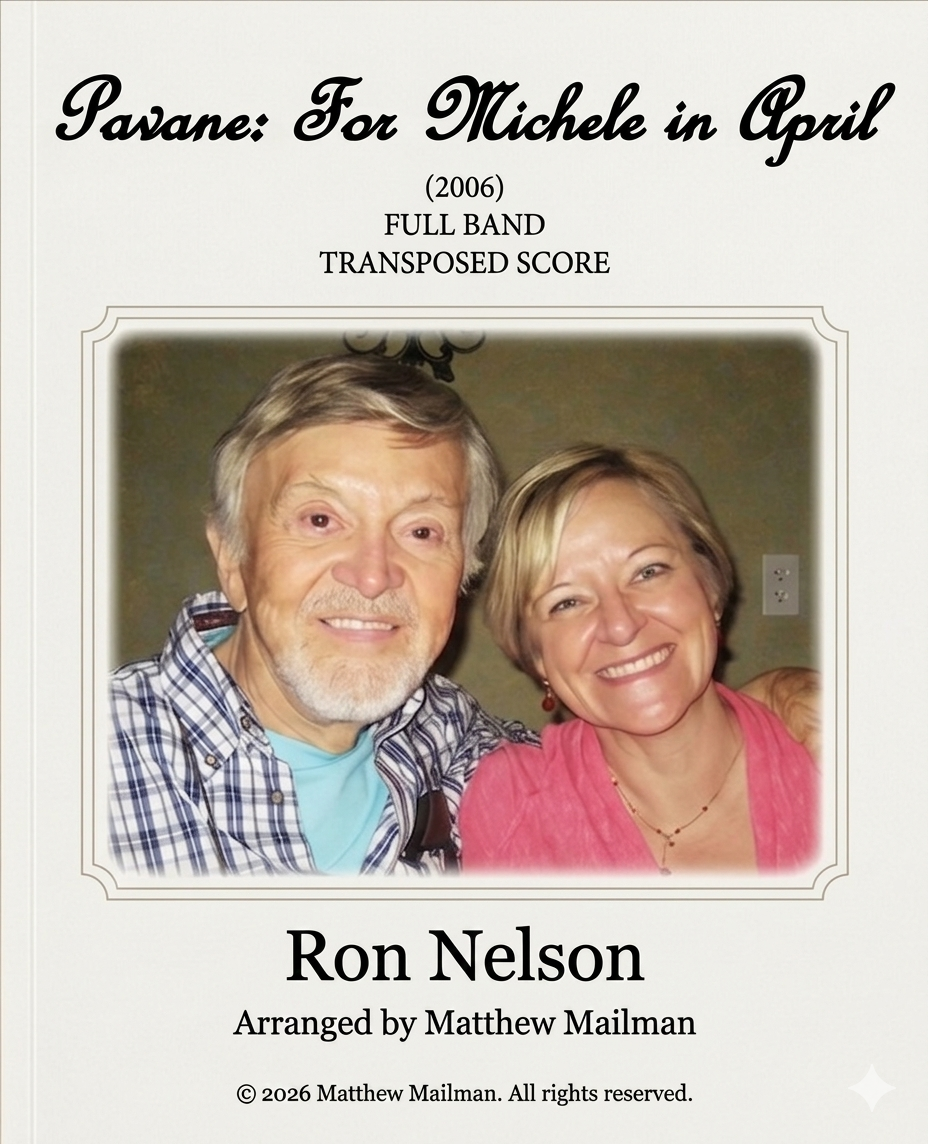
Enjoy the premiere performance of Pavane: For Michele in April by the Oklahoma City University Wind Ensemble, Matthew Mailman, conductor on November 6, 2025!
To view the concert premiere, visit this link!
FROM MICHELE NELSON (November 11, 2025):
Matt, I listened to Thursday’s performance of Pavane for Michele in April. My god, what a performance! Your arrangement was Ron in spirit form, and the group played so beautifully! I could see and hear that not only you, but the kids themselves poured their hearts into it.
I was up so late last night, sending the YouTube performance to a zillion people. I’ve had so many responses, and everyone just loves not only the piece, but what you did with it. Ron’s daughter, Kris, said last night, “Man, that arrangement sounds just like Dad!” And Ron’s son, Marc, commented on what an elegant and amazing conductor you are. Two friends sent me messages on FB about how they were in tears. You nailed it, my friend. I’ve listened to/watched the video about 20 times and will be obsessed with it again today.
I am moved beyond words. I thank you from the very bottom of my heart for all you’ve done and continue to do out of love for Ron. It means more than you know to have you take this on, and I’ll never be able to thank you enough for this once-in-a-lifetime gift. Love you, my friend. Thank you again.
INSTRUMENTATION
Piccolo
Flute 1
Flute 2
Oboe
English Horn
Bassoon 1
Bassoon 2
Contrabassoon
Clarinet in B-flat 1
Clarinet in B-flat 2
Clarinet in B-flat 3
Bass Clarinet in B-flat
Alto Saxophone in E-flat 1
Alto Saxophone in E-flat 2
Tenor Saxophone in B-flat
Baritone Saxophone in E-flat
Trumpet in B-flat 1
Trumpet in B-flat 2
Trumpet in B-flat 3
Trumpet in B-flat consolidated
(use only in lieu of the other trumpet parts)
Horn in F 1
Horn in F 2
Trombone 1
Trombone 2
Bass Trombone
Euphonium
Tuba
Double Bass
Harp
Timpani
Glockenspiel
Vibraphone
Piano (use only if there is no harp)
BIOGRAPHY
Born: December 14, 1929, Joliet, Illinois
Died: December 24, 2023, Scottsdale, Arizona
Ron Nelson wrote his first composition at age six and began studying piano that same year. He taught himself to play string bass in order to play in the Joliet Township High School band. The director, Bruce Houseknecht, encouraged him to compose, so Dr. Nelson wrote a twenty-two-minute concerto for piano and symphonic band, which he performed at age seventeen. He studied composition at the Eastman School of Music with Howard Hanson and Bernard Rogers. Dr. Nelson earned his BMus degree in 1952, MMus in 1953, and DMA in 1956, all from Eastman. He went to Paris in 1954 on a Fulbright Grant and studied at the École Normale de Musique and the Paris Conservatory with Tony Aubin. Returning to Eastman, he became involved with film music. Following graduation, he joined the music faculty of Brown University in 1956, served as Chairman of the Music Department from 1963 to 1973, and in 1991 became the first musician to be awarded the Roy Acuff Chair of Excellence in the Creative Arts. Upon his retirement in 1993, he was named professor emeritus. Some of his works for band include Rocky Point Holiday (1969), Aspen Jubilee (1984), Resonances I (1991), Morning Alleluias (1991) and Passacaglia (Homage on B-A-C-H) (1992). His entire oeuvre can be accessed at www.ronnelson.info.
Dr. Nelson was awarded an Honorary Doctorate of Music by the Wanda L. Bass School of Music at Oklahoma City University on May 11, 2006. He received commissions from the Rochester Philharmonic Orchestra, the United States Air Force Band and Chorus, the Rhode Island Philharmonic Orchestra, the National Symphony Orchestra, and numerous choral organizations, colleges, and universities, including the University of Minnesota, Dartmouth, Western Michigan, and Lawrence, as well as the Classic Chorale Brevard Music Center and Aspen Music Festival. He also received grants and awards from the Howard Foundation, ASCAP, Brown University, and several from the National Endowment for the Arts. Dr. Nelson was the distinguished winner of the 1993 ABA/Ostwald, the NBA Composition Contest, and Sudler International Wind Band Composition Competition (The John Philip Sousa Foundation), for his work Passacaglia (Homage on B-A-C-H) (1992).
Conductor Leonard Slatkin described Dr. Nelson thusly: “Nelson is the quintessential American composer. He has the ability to move between conservative and newer styles with ease. The fact that he’s a little hard to categorize is what makes him interesting.”
ARRANGER’S NOTE
I knew Ron Nelson for my entire life. He and my father were best friends for almost 50 years from the time they were students at Eastman until my dad’s passing, and they shared many good times and many laughs. Ron and his wife Michele have always been like family to me, and, in fact, he was like a second father to me. I had the honor of performing many of Ron’s pieces over the years. For many years during the summers when I was creating my repertoire lists for the year, I would ask him what piece of his he would like for me to program that year, then oblige his suggestions. My institution, the Wanda L. Bass School of Music at Oklahoma City University, was honored to grant Ron an honorary Doctorate of Musical Arts on May 11, 2006.
While I had the honor of working with Ron in musical settings (both in person and long-distance) since the time I was a high school percussionist, I also had the joy of his consistent close friendship, encouragement, and mentoring. I cannot imagine what my career would have been without Ron Nelson and his music. I was always a better musician after conducting his works. Having the opportunity and privilege in 2018 to collaborate with Ron on the development of "Homage to Landini", the missing movement from his monumental Medieval Suite and his last ensemble project, was one of the greatest moments of my career and life.
It was an honor to be entrusted by Michele with this work Pavane. Ron once told me that his best-selling work was Courtly Airs and Dances but he didn’t know why. I told him it was because the way it was written to be so accessible by so many ensembles, any band sounds good playing it. I kept that in mind when I arranged Pavane.
Some preferences……use a harp if you have one. If not, use a piano (there is a dedicated piano part which is different from the harp part). Do not use both, and if possible, do not use an electric keyboard for the harp. There is also a consolidated trumpet part available (which covers all three trumpet parts) for younger bands.
I miss Ron dearly, and there is so much more I could say, but hopefully much of it will be said through performances of his music that continue to honor and celebrate the life of this remarkable, beautiful man. His music will continue to inspire, and the warmth of his friendship will linger in the hearts of those who were fortunate enough to share in his life.
- Matthew Mailman
SPECIAL THANKS
Michele Nelson
Logan Edwards, editor
Luis Francisco Venegas, Performance Manager, Wanda L. Bass School of Music
Dr. Tommy Dobbs, Professor of Percussion, Wanda L. Bass School of Music
Dr. Emily Duncan, Professor of Harp, Wanda L. Bass School of Music
Dr. Sergio Monteiro, Professor of Piano, Wanda L. Bass School of Music
Ryan Batt, Wanda L. Bass School of Music harpist
Travis Pardee, Director of Bands, Foothill High School, Henderson, NV